aHUS has a wide range of symptoms depending on which organs are affected.1,2,4 The initial symptoms are usually nonspecific, such as fatigue or tiredness, pale skin and sleepiness or drowsiness.2 Kidney failure is one of the most common symptoms.1-3

What is aHUS?
Atypical haemolytic uremic syndrome (aHUS) is a rare and serious disease that affects both adults and children.1-3 aHUS is a condition caused when the complement system, which is part of the body’s immune system, becomes overactive.1-4
This leads to the thrombotic microangiopathy (TMA), which in aHUS is known as complement-mediated TMA because it involves uncontrolled complement activation and organ damage.1-3,5-7
TMA is a group of diseases, which includes aHUS and is characterised by the formation of blood clots in small blood vessels resulting from damage to blood vessel walls due to the defect or fault in the complement system.1-7
TMA can lead to damage to organs such as the kidneys, heart and brain, and can stop some organs from working properly.1-7 TMA most commonly affects the kidneys.
In individuals with aHUS, uncontrolled activation of the complement system causes damage to the cells lining blood vessels, leading to formation of blood clots. Red blood cells become trapped in the blood clots. Any red blood cells that are able to pass through the blood clots become damaged or destroyed, resulting in haemolytic anaemia. The damaged red blood cells are called schistocytes and it is a hallmark characteristic of aHUS. The blood clots and inflammation of the blood vessel wall reduce blood flow to the organs. This leads to organ damage and reduced organ function that can be potentially life-threatening.
A triggering event or other clinical condition might be associated with aHUS.1,3,4 The trigger event can be an infection, pregnancy, medications, kidney transplant or an autoimmune disease such as systemic lupus erythematosus.1,3,4

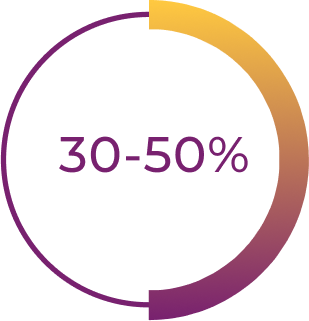
In 30-50% of patients there is no identified disease genetic cause.8–12
Identification of genetic mutations is not required for aHUS diagnosis.8,9,13
aHUS has a wide range of symptoms depending on which organs are affected.1,2,4 The initial symptoms are usually nonspecific, such as fatigue or tiredness, pale skin and sleepiness or drowsiness.2 Kidney failure is one of the most common symptoms.1-3

.Fatigue or tiredness
.Pale skin
.Sleepiness or drowsiness

.Blood in the urine (haematuria)
.Low urine production (oliguria)
.Reduced kidney function
.Kidney failure

.Headache
.Confusion
.Seizures
.Stroke

.Fluid build-up (pulmonary oedema)
.Bleeding (pulmonary haemorrhage)
.Shortness of breath (dyspnoea)

.High blood pressure (hypertension)
.Fast heart rate (tachycardia)
.Heart attack

.Diarrhoea
.Vomiting
.Abdominal pain

Detecting aHUS early makes managing and treating the condition easier, and may lead to better outcomes.
If you spot any of the symptoms above, speak to your doctor.
References: 1. Raina R, et al. Cells. 2021;10:3580. 2. Yerigeri K, et al. J Multidiscip Healthc. 2023;16:2233–49. 3. Avila Bernabeu AI, et al. Nephron. 2020;144:537–49. 4. Formeck C, et al. Pediatr. Nephrol. 2019;34:1337–48. 5. Palma LMP, et al. Kidney Int Rep. 2021;6:11–23. 6. Timmermans SAMEG,
et al. J Clin Med. 2021;10:3034. 7. Yan K, et al. Clin Epidemiol. 2020;12:295–305. 8. Azoulay E, et al. Chest. 2017;152(2):424-434. 9. Afshar-Kharghan V. Hematology Am Soc Hematol Educ Program. 2016;2016(1):217-225. 10. Noris M, et al. Genetic Atypical Hemolytic-Uremic Syndrome. 2021. Available at: https://www.ncbi.nlm.nih.gov/books/NBK1367/. Last accessed September 2025. 11. Loirat C, et al. Pediatr Nephrol. 2016;31(1):15-39. 12. Noris M, et al. Clin J Am Soc Nephrol. 2010;5(10):1844-1859. 13. Laurence J et al. Clin Adv HematolOncol. 2016;14(11 suppl 11):2–15.
Approval ID: IN-17001 | Approval Date: 24/09/2025 | Approval Expiry Date: 24/09/2027